
Star Wars Outlaws - Reputation System Breakdown
- Genre: Sci-fi, Action-adventure
- Gameplay: Open-world, Shooter
- Perspective: Third-person
- Setting: Star Wars
- Narrative: Crime
- Developers: Massive Entertainment, Ubisoft.
Experience the underworld of the Star Wars universe with Kay Vess, while she navigates crime syndicates and takes high-stakes jobes in her quest from freedom and a fresh start.

All analyses involve interpretation and therefore contain a degree of subjectivity. As an external observer, I do not have access to the full development context; still, I will try to dissect the system’s intent and its components. The following reflections are educational and based on my game design and player experience.
The reputation system is central to Star Wars Outlaws’ design as it interacts with multiple systems and feeds into the player experience. My goal is to uncover the design intent, break down the reputation system and analyze how it influences neighboring systems.
Vision
Julian Gerighty, the creative director of Star Wars Outlaws, mentioned that the team’s favorite character, Han Solo, sparked the fantasy of playing an outlaw. Stealth, combat, fisticuffs, hanging out in shady cantina and having meaningful choices and consequences were central to their player fantasy. ‘’In this world, Julian said, you live or die by your reputation as a scoundrel.’’ It is safe to say that the reputation system exists because the team at Ubisoft envisioned it to be an essential part of the outlaw experience.
The Outlaw Fantasy
An outlaw lives outside the protection of the law and is therefore stripped of their basic safety. It is this need for safety and the insecurity of requiring it that creates ongoing tension. Especially when Kay’s Vess goals don’t align with other factions’ ambitions, goals collide, and safety evaporates. A perfect example of this is the Terrible reputation tier, where factions will send in kill squads to hunt Kay. Hence, this feature exists to generate tension in the game and thereby influences its difficulty level.
Honor, dignity and property are often seen as core concepts of reputation. It is the state of being worthy of respect and a form of social wealth that is possessed and needs to be protected. In a certain way, reputation is a currency that determines someone’s influence and authority within a community. Therefore, it is essential to understand which virtues are considered relevant by the community as its social judgment.
Star Wars Outlaws tries to incorporate the protection of social wealth by making its reputation scale fluctuate between activities depending on whether Kay honors or betrays the deal. Her influence and authority are demonstrated by the access to areas, merchants, contract opportunities and price deals she obtains. The tradeoff of double-crossing someone is often displayed as a choice between credit (money) and reputation. Forcing the player to make a choice about which currency is of greater importance to them.
This all demonstrates that Star Wars outlaws really tried to incorporate the complexity of reputation in an underworld setting and was right to set it as the games core system.
The Reputation system
Factions
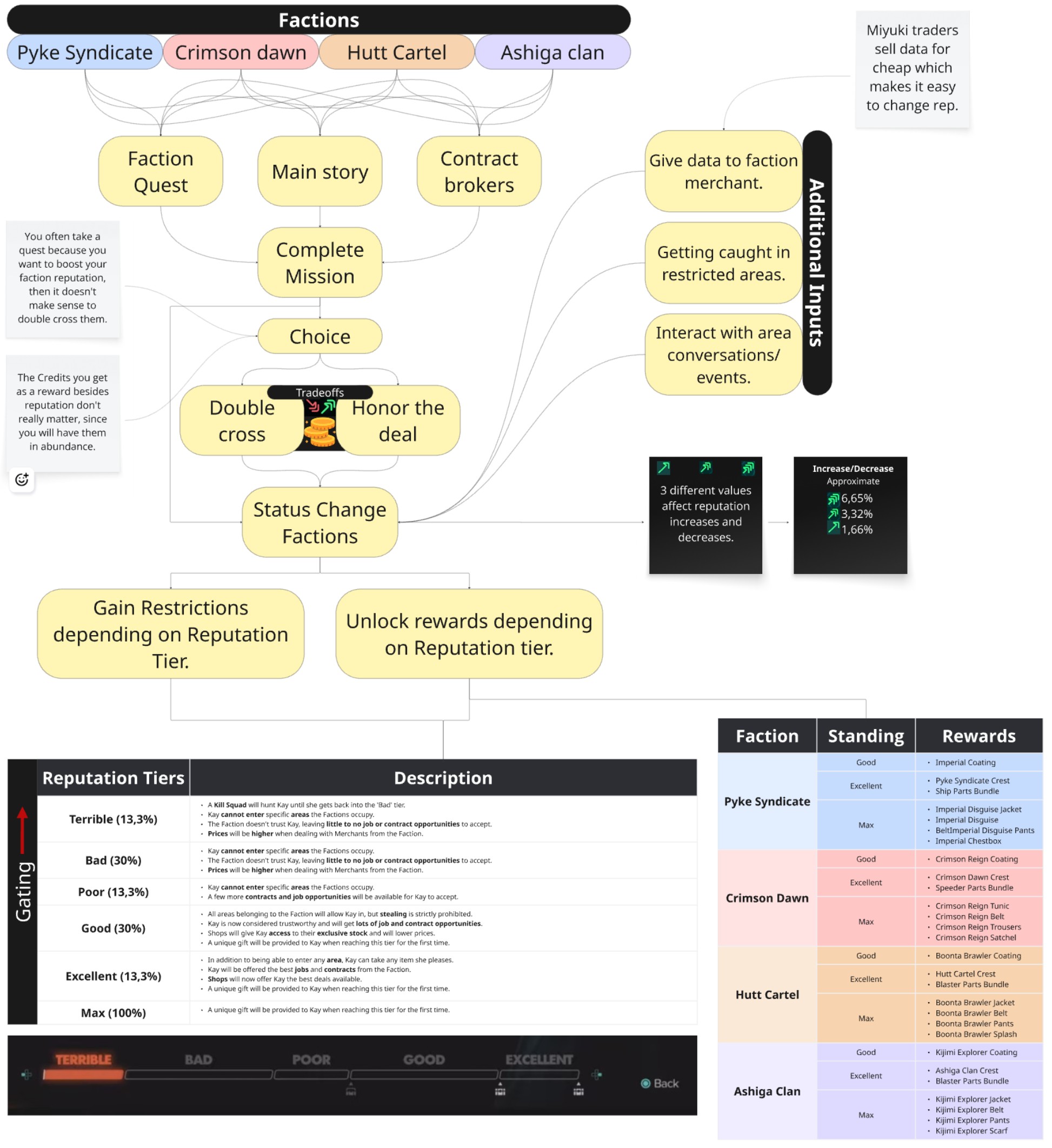
Four factions are tied to the reputation system in Star Wars Outlaws: the Hutts, Pyke’s, the Ashiga clan and Crimson Dawn. While these factions have their distinct moral codes, they don’t behave differently in gameplay. The difference mainly lies in the rewards one can get for having a good or excellent standing.
Inputs
The player can gain and lose reputation through interacting with the main story, contract brokers, factions’ quests, getting caught in restricted areas, participating in area conversations and events and by giving data to faction merchants.
Choices
Sometimes at the end of a mission, quest or contract you will be presented with a choice to double-cross the quest giver in favor of more money or reputation. Which is a lovely thought, but in practicality, it will rarely be appealing to betray the faction because you were motivated to boost the quest givers’ faction reputation. The monetary reward of credits doesn’t matter enough because you often have it in abundance, since upgrade materials are gated by story progression. In short, the reward is often not big enough to double-cross. Which is a pity, because it shows that the system isn’t balanced enough to require careful decision making.
The consequences of these choices are tied to enemy behavior, area restrictions, job and contract opportunities and merchant prices. Which is lovely but can sometimes feel very systemic, because they often don’t present dilemmas or opportunities to move the story forward. They don’t carry narrative consequences, which reduces the player agency quite a bit.
Reputation values
The amount of reputation the activity delivers is always indicated by a green (increases) or red arrow (decreases). There are three potential value increases or decreases that influence the reputation scale and cause it to fluctuate between activities depending on who you’re honoring or betraying (see figure 1).
Trespassing decreases reputation often with a small amount but murdering a lot of people in a hideout gives the same trespassing decrease, while the crime committed is much higher. This sometimes creates ludonarrative dissonance as it contradicts the outlaws fantasy in tension and hunger for safety. The small punishment is probably made to be forgiving towards players with different skill levels, but I think a better solution would have been to introduce ‘repair’ missions, that boost you reputation up in case you fall back into the terrible tier.
Rewards
The rewards you gain from having a good faction standing are mechanically very satisfying because they alter attributes in different ways. For example, increasing adrenaline, restoring health, increasing accuracy, avoiding detection, increasing movement speed etc.
Neighboring systems
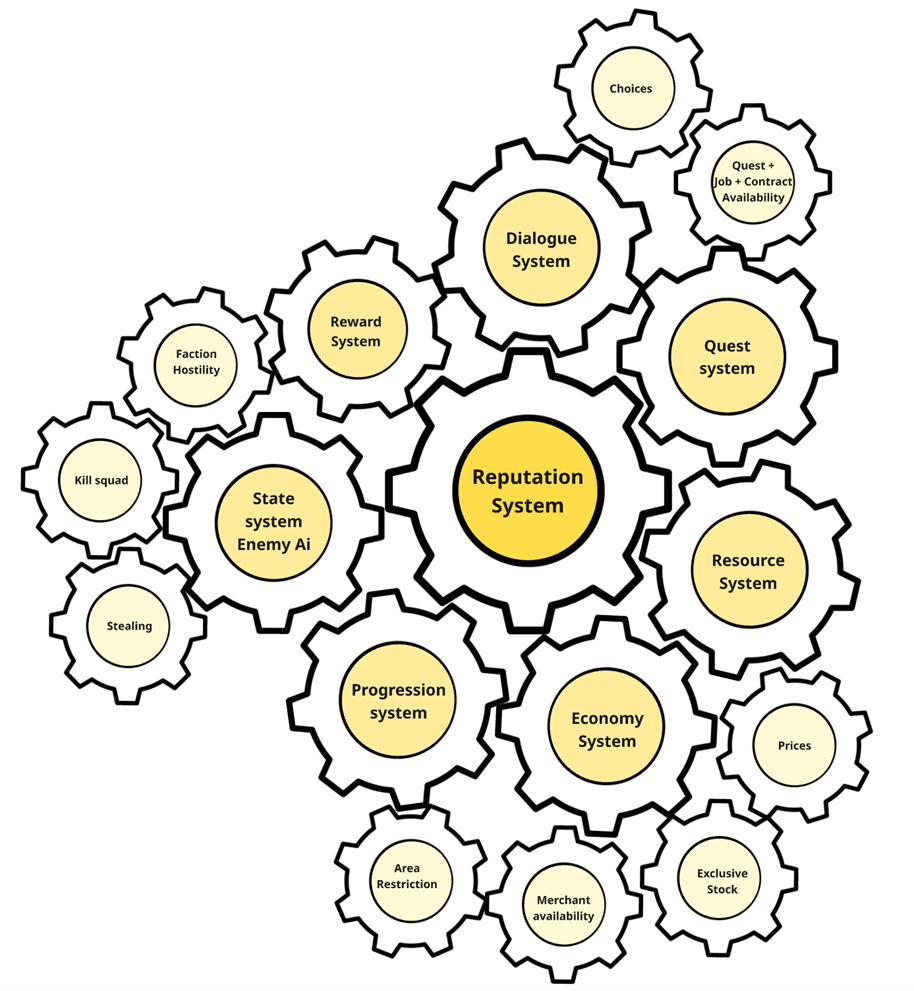
Lead system designer, Matthieu Delisle, mentioned that the reputation system became the foundation of the game and that all features are connected to it. Which would take a lot of time to recreate, so I did my best to give a small overview of the most important ones:
Conclusion
I think the team at Ubisoft can be proud of the reputation system they created. It truly embodies the complexity of reputation and what reputation means for an outlaw. It’s clear that the systems integration didn’t come cheap. If I had the budget, I would have done the following to improve the player experience:
- Fine-tune the balance of the reputation system. Punish crimes accordingly and give players a few repair missions.
- Nerf Miyuki traders. You don’t want the player to buy their way into the top because it evaporates all tension (risk/reward).
- Make the trade-offs more appealing by, for example, offering rare materials for upgrading your ship or speeder and, – or by presenting narrative dilemmas with NPC’s of a faction.
- Tie a unique enemy (ai) behaviour to the faction’s moral code.
- Give Kay the ability to exercise influence on the faction in a meaningful way and not just unlock gated content.